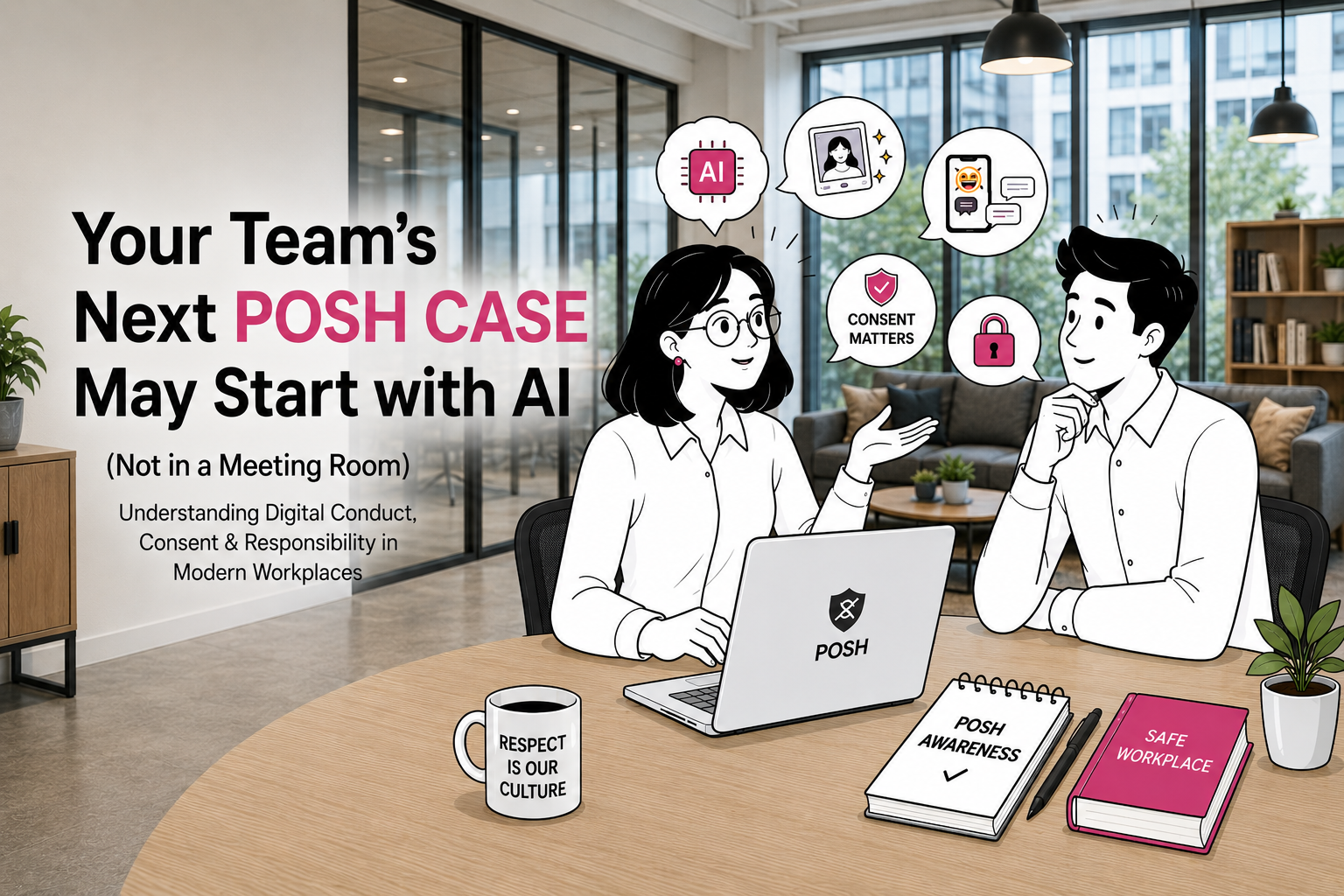
Your Team’s Next POSH Case May Start with AI
(Not in a Meeting Room)
A few years ago, most workplace harassment conversations revolved around:
- physical spaces,
- inappropriate comments,
- power dynamics,
- office interactions,
- and visible misconduct.
Today, that landscape has changed dramatically.
The next major workplace issue may not begin:
- in a cabin,
- at an offsite,
- or during a meeting.
It may begin with:
- a screenshot,
- an AI-generated image,
- a meme,
- a WhatsApp group,
- a voice clone,
- or “just a joke.”
And that shift is forcing organizations to rethink what workplace conduct really means in the digital age
The New Workplace Reality
Modern workplaces are:
- hyperconnected,
- digitally social,
- AI-enabled,
- and constantly online.
Teams collaborate through:
- WhatsApp,
- Slack,
- Teams,
- Instagram DMs,
- AI image tools,
- collaboration apps,
- and informal digital groups.
The boundaries between:
- “workplace,”
- “social space,”
- and “personal interaction”
are becoming increasingly blurred.
That is where the real challenge begins.
Because workplace culture now exists online as much as offline.
When “Fun Culture” Crosses the Line
Many organizations today proudly describe themselves as:
- informal,
- meme-heavy,
- startup-driven,
- youthful,
- high-energy,
- and socially connected.
None of that is inherently wrong.
In fact, strong workplace camaraderie can improve:
- engagement,
- collaboration,
- belonging,
- and morale.
But without maturity, awareness, and boundaries, “fun culture” can quietly evolve into:
- exclusion,
- humiliation,
- objectification,
- bullying,
- or harassment.
And AI has amplified this risk exponentially.
Today, with a few clicks, employees can:
- edit photos,
- generate fake scenarios,
- create deepfakes,
- clone voices,
- manipulate images,
- or circulate altered content instantly.
The problem is not only the technology.
The problem is how casually people may use it without understanding:
- consent,
- dignity,
- impact,
- psychological safety,
- or workplace consequences.
“But We Didn’t Mean Harm.”
This is one of the most common responses organizations hear when digital misconduct surfaces.
And in many cases, it may even be true.
Most workplace issues do not begin with malicious intent.
They begin with:
- normalization,
- lack of awareness,
- peer validation,
- group humour,
- poor boundaries,
- and collective immaturity.
People laugh together.
Nobody objects openly.
The behaviour escalates gradually.
Discomfort remains invisible until it becomes unbearable.
That is why organizations must understand an important principle:
Intent alone does not define workplace impact.
Someone may believe:
“It was harmless.”
But the affected employee may experience:
- humiliation,
- anxiety,
- objectification,
- isolation,
- fear,
- or emotional distress.
And often, by the time HR becomes aware, trust has already been damaged.
Public Photo Does Not Mean Public Consent
One of the biggest misconceptions in digital workplaces is this:
“The image was already on LinkedIn.”
But public visibility is not the same as workplace consent.
Uploading someone’s image into:
- AI tools,
- meme generators,
- “beauty filters,”
- romantic simulations,
- glamour edits,
- or manipulated scenarios
without their comfort or consent can become deeply inappropriate — even if intended as humour.
The digital world has created a dangerous illusion:
that access equals permission.
It does not.
Why This Is Becoming a Leadership Issue
This conversation is no longer only about HR or compliance.
It is now a leadership maturity issue.
Because modern workplace risks today involve:
- reputation,
- culture,
- trust,
- employer branding,
- retention,
- psychological safety,
- and governance.
Employees now judge organizations not only by:
- compensation,
- benefits,
- or flexibility,
but by:
- emotional safety,
- respect,
- inclusivity,
- and how leadership responds during uncomfortable situations.
The organizations that handle these situations maturely build trust.
The ones that dismiss them as “overreaction” often create deeper cultural damage.
The First Mistake Organizations Make
When such incidents surface, many organizations instinctively respond with:
“It was just a joke.”
This is usually the worst possible starting point.
Because immediate dismissal:
- invalidates employee discomfort,
- discourages reporting,
- normalizes inappropriate behaviour,
- and signals cultural indifference.
The first responsibility of leadership is not immediate judgment.
It is responsible listening.
What Organizations SHOULD Do First
1. Take the Concern Seriously
Even if the facts are still unclear.
Employees should never feel:
- mocked,
- dismissed,
- or minimized for raising discomfort.
The first response shapes whether employees trust the process.
2. Preserve Digital Evidence
Organizations should:
- secure screenshots,
- preserve chats,
- retain digital records,
- document timelines,
- and prevent deletion or circulation escalation.
Digital misconduct spreads quickly.
Early preservation matters.
3. Separate Intent from Impact
HR and leadership should avoid immediately concluding:
- “They meant no harm.”
The right question is:
“What was the impact on the affected employee and workplace environment?”
4. Avoid Public Discussion
One of the biggest organizational mistakes is informal gossip after escalation.
Managers and employees should avoid:
- speculation,
- side-taking,
- WhatsApp debates,
- and public commentary.
Poor handling can worsen emotional harm and legal exposure.
5. Assess Whether It Falls Under POSH, Misconduct, or Both
Not every digital issue automatically becomes a POSH matter.
But organizations must evaluate:
- sexual undertones,
- humiliation,
- unwelcome conduct,
- hostile environment creation,
- objectification,
- power dynamics,
- and gendered impact.
Sometimes the issue may involve:
- POSH,
- code of conduct,
- cyber misconduct,
- bullying,
- retaliation,
- or all of them together.
6. Protect Psychological Safety
The affected employee may:
- withdraw socially,
- avoid meetings,
- lose confidence,
- reduce participation,
- or fear retaliation.
Organizations must ensure:
- confidentiality,
- emotional safety,
- non-retaliation,
- and respectful handling.
What Organizations SHOULD NOT Do
1. Do Not Force Immediate Closure
Avoid:
“Let’s settle this informally.”
Premature closure often protects comfort over accountability.
2. Do Not Blame Sensitivity
Statements like:
- “People are too sensitive nowadays,”
- “This generation overreacts,”
- “It was harmless fun”
can severely damage trust.
3. Do Not Turn It Into a Public Spectacle
Investigations should not become:
- gossip,
- public examples,
- humiliation exercises,
- or leadership theatre.
4. Do Not Focus Only on Legal Risk
The biggest damage is often cultural, not legal.
Organizations lose:
- trust,
- credibility,
- retention,
- and psychological safety long before lawsuits happen.
The Maturity Modern Organizations Need
The future of workplace culture will depend heavily on digital maturity.
Organizations now need:
- AI usage frameworks,
- digital conduct awareness,
- consent conversations,
- manager sensitization,
- psychological safety education,
- and stronger leadership accountability.
Most importantly, organizations need employees to understand this:
Digital behaviour is workplace behaviour.
Respect does not disappear because interaction happens through:
- a screen,
- an app,
- a meme,
- or an AI tool.
The Bigger Question
The real question organizations should ask is not:
“Can this become a POSH case?”
The better question is:
“What kind of workplace culture are we normalizing?”
Because culture is rarely shaped during formal training sessions.
It is shaped in:
- jokes,
- reactions,
- silence,
- leadership behaviour,
- group dynamics,
- and everyday digital conduct.
Final Thought
Technology is evolving rapidly.
AI tools will become:
- more accessible,
- more realistic,
- and more deeply integrated into everyday work culture.
Which means organizations now have two choices:
Either:
- wait for policies and complaints to catch up,
or proactively build:
- awareness,
- maturity,
- empathy,
- boundaries,
- and responsible workplace behaviour.
Because the next major workplace risk may not begin in a meeting room.
It may begin with:
“Guys, look what I made using AI.”